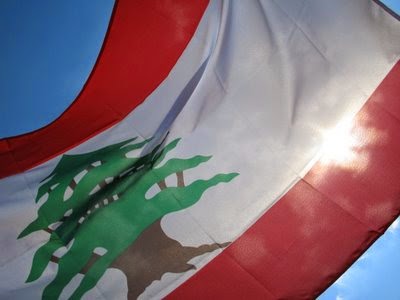
Come with Me from Lebanon, My spouse; with Me from Lebanon. 8
Look from the top of Amana, from the top of Shenir and Hermon,
from the lions' dens, from the mountains of the leopards.
….
Your lips, My spouse, drip like the honeycomb;
honey and milk are under your tongue.
And the scent of your garments is like the scent of Lebanon.
…
Your plants are an orchard of pomegranates with excellent fruits,
with henna and spikenard;
spikenard and saffron, calamus and cinnamon;
with all trees of frankincense, myrrh and aloes;
with all the chief balsam spices;
a fountain of gardens, a well of living waters;
even flowings from Lebanon. 15
Song of Solomon 4; 8-15
Book Reviewed: A House of Many Mansions - The History of Lebanon Reconsidered,
By Kamal Salibi.
Between February 14, 2005 and March 14, 2005, following the assassination of Lebanon’s beloved Prime Minister Rafic Hariri, an estimated 1.5 million people had marched in downtown Beirut. Eighty-five years after the formation of Le Grand Liban in 1920, and on the 30th anniversary of the outbreak of the civil war in April 1975, something new, amazing, and precious was born in Lebanon: an indigenous, responsive, truly plural form of common purpose that was not fabricated, but forged out of a long and difficult experience. The demonstrations were manifestation of the Lebanese people’s power and will, and a pledge of allegiance. Regardless of their roots, the demonstrators were all Lebanese, not Arab, not Phoenician, not Christians, and not Muslim.
Lebanon’s own Khalil Gibran wrote, "Your pain is nothing but the breaking of the shell that encloses your understanding”. It is the understanding of Lebanon that broke the shell, and it is the pain and suffering of a nation that drove Professor Kamal Salibi to write, in 1998, “not a history of Lebanon, but a critical study of different views of Lebanese history” (Salibi 3). The significance of this book is that it was written when Lebanon “in all but name, [was] a non-country” (2). At the worst period of modern Lebanese history, when the country was at the brink of collapse, Professor Salibi , to the astonishment of many, remarked that “the Lebanese are finally beginning to discover themselves […] sharing the same national identity, regardless of other loyalties” (3).
Salibi (1929- ), a Professor Emeritus of History at the American University of Beirut, is no doubt Lebanon’s foremost living historian. He has written several books that caused an outcry, namely his theory that the pre-exilic Jews never lived in Palestine, in his books The Bible Came from Arabia, and The Secrets of the Bible People. He also wrote Who was Jesus? A Conspiracy in Jerusalem. Salibi’s historic specialization, in my opinion, is the “debunking of deeply rooted myths” (Fawaz). Salibi’s role as a historian is not to discover the past, but mainly to uncover its underlying truth, and this elicits angry “responses and indignant condemnations” (4): Those were his own words in one of his more radical books, Who was Jesus? A Conspiracy in Jerusalem. In the last paragraph of that book, he outlines his line of thinking: unless the historians “manage to provide convincing answers to all the questions which mankind has asked since the beginning of human existence, they cannot justly claim that nothing truly meaningful lies beyond the jigsaw pieces of factual reality, which is the most that the historian – even with the mind’s thousand eyes- can ever hope to see” (193). A previous Director of the Department of History at the American University of Beirut, he was the founding Director of Royal Institute of Interfaith Studies based in Jordan (retired December 2003). The institute focuses on the interdisciplinary study of religion and religious issues, particularly as they relate to Arab and Islamic society, with special concentration on Christianity in the Arab world. Professor Salibi lives near the American University of Beirut; he is described as “a committed Presbyterian Christian.”
Salibi examines the historical myths on which Lebanon’s warring communities have based their conflicting visions of the Lebanese nation and its historical legitimacy, and seeks the “meaningful” truths that lie beyond the jigsaw pieces of factual reality. The book explores the roots of the [then ongoing] struggle between what Salibi calls “Arabism” and “Lebanism,” at whose heart “are different views of Lebanese history which, as it happens, are mostly quite unhistorical” (Gilmour). Although “differences of interpretation are also signs of growth” (Gustavson 173), they were signs of severe disruption.
“Arabism” claims that Lebanon is an Arab country. The author discounts “erroneous Arab nationalist view of this history […] as parochial history” (231). “There had never been such a thing as historical Arabism” (215), which “was little more than another name for Islam” (50). The nationalist view of the Arab identity was a reaction against attempts to force Turkish nationalism on the Ottoman ruled regions, in 1908, which “alienate[d] Muslim Arabs and force[d] them to develop a nationalism of their own” (47).
“Lebanism” did not stand a better fate than “Arabism.” Not only did “Lebanism” fail to rally the different composites of a Lebanese nation, it seriously failed to stand up to scrutiny. Henri Lammens’ 1921 book, La Syrie: precis historique imagined Lebanon as a Phoenician refuge, invoking a pre-Islamic and pre-Arab history. To Salibi, the claims of Lebanon as a “long existing political entity,” “Phoenician,” or “mountain refuge,” are not historically founded. Salibi maintains that Lebanon as a territorial state did not come into political existence until 1920, contrary to the claims of a previously existing unified Lebanese nation-state. Salibi rejects the Lammens view of Lebanon as the historical refuge of persecuted minorities fleeing from Muslim rule; most people did not come to Lebanon as refugees, but those who did, namely the Christian Maronites, around 1000 A.D., having lived in the Orontes valley under Islamic rule for more than three centuries, came seeking sanctuary from Christian Byzantine persecution than to escape Muslim authority, especially that Lebanon has been under Muslim control since 638 A.D. On the other hand, little is known of the Phoenicians, “between ancient Phoenicia and the Lebanon of medieval and modern times, there is no demonstrable historical connection” (177). However, “what makes the Lebanese so much like the Phoenicians of old is geography, not history […] Geography in some respects can be as important as history” (178). Salibi adopts a Braudelien perspective, the longue durée explains how the peoples that inhabited Lebanon, and their mentality, were molded into the likes of Phoenicians. In view of that, “in Lebanon alone [in the Arab world] the impact of the modern world arrives with grace, stage by stage, and often upon local invitation; and the accommodations to it also came gradually and with equal grace” (165). In my opinion, Salibi missed, or saw as irrelevant, an important fact. A people, let us call them the “indigenous Lebanese,” inhabited Mount Lebanon and the fertile coastal strips in the ancient times. Throughout history, there has not been a recorded mass immigration of a single group out of Lebanon. Therefore, it is safe to assume that the “indigenous Lebanese” mixed with the “new comers.” Moreover, for a small territory to take-in 17 religious denominations and ethnicities, there must have been a good reason: Lebanon might not have been the historic stronghold, but it was certainly a natural and social safe haven for this variety to live unthreatened and somehow preserve the groups’ particularities.
Preserving particularity when integration is required represent a challenge for multi-ethnic countries. “For any people to develop and maintain a sense of political community it is necessary that they share a common vision of their past” (216). Sharing vision of the past is a completely different lot from sharing the same past. Although Salibi seems to agree with Tosh’s statement on the political objective of history (Tosh 6), he warns of indulgence in nationalistic “historical self deception” which some nations could not afford (217). Salibi deduces that “administrative bureaucracies, flags and national anthems [are not] sufficient to make a true nation-state out of a given territory and the people who inhabit it” (27).
History is a discipline that claims to recount the past, create national pride, and pass on collective memory through the ages. Contrary to administrative bureaucracies, ideas and ideologies, such “Arabism,” and “Lebanism,” “are threads which bind the minds of men together sufficiently for joint action to occur” (Gustavson 153). On the other end of the thread, those ideas can be remolded and amplified to serve certain political purposes or structures, “with devastating consequences” (154).
Arab nationalists claimed that Lebanon was essentially and indistinguishably part of the Arab world, they refused to be detached, not realizing that “Arabism” was itself an invention as much as “Lebanism” was, and that Lebanon had indeed a special character. In contrast, “Lebanism” was an attempt to create a non-Arab past to justify the country’s enrooted distinctiveness and right of existence, by going to an opposite but shaky extreme. Both parties unwittingly fell prey to their own historical myths. However, historical perspectives change because of “different political agendas, different cultural assumptions, and different historical methodology with new focuses and new accepted wisdom” (Wilson 3).
For history to be socially meaningful and useful “it has to be given all the relevant dimensions” (234), otherwise, it is better forgotten. History is “a search for understanding; and the house of understanding has many mansions” (234). Therefore, Salibi’s “new wisdom” was that the Lebanese should subscribe to “clean slate” of history (219); Lebanon’s history before 1920 is best forgotten. What could have developed during the war that leads to this seemingly unusual recommendation from a renowned historian?
In 1987, Salibi drew attention to a radical social change: a free and deliberate political choice of belonging to the Lebanese state, to an adopted country.
The people or peoples of any society are what are relevant for the validation of any idea. Conflicting ideological wars and not carried out in abstract political, economic, or social systems, but in the minds and lives of people. People in the society are the perpetrators and the victims. Ideas drive people, but it is in their suffering that the pending questions finally find their answers. If gradual development and evolution of England had “long continued without foreign invasions and consequent disruption of native institutions” (Gustavson 71), the development of Lebanon was the exact opposite. A large part of the people, namely the Sunnite Muslims, were “dragged into” a political entity they disclaimed, but of which they were an integral constituent. Another part of the people, the Christian Maronites, denied their broader cultural and ethnic background, and instead, in the minds of the opposed camp, aggravated the notion that this country was fake. The other groups, the Druze and the Shiites, for religious reasons, do not recognize the Islamic history as a true history (206), and did not wish “to be dominated by a Sunnite ruling class in the name of Arabism than Christians did” (53) , but they could not see themselves in the picture the Maronites were drawing either. In this aspect, Salibi “provides a lasting contribution to the understanding of how in all periods and places history is used and abused” (Fawaz).
Fortunately, “thinkers are the sensitive antennae of society, the first to sense keenly that attitude of the emerging age […] when a changing society finds the hitherto predominant sentiments , formerly satisfactory, becoming less convincing” (Gustavson 155). A historian’s role is not confined to the description of events. In that aspect, Salibi did not only give account of a failed attempt to create a national history for a modern state, “he keenly sensed the attitudes”: After 13 years of war, many things have changed in the society- in Wilson’s words- the “political agendas and cultural assumptions.” Salibi saw indications of a more constructive attitude among the Lebanese; he saw a homogenization of society through common grief and common experience; on the political level, the recognition, after 13 years of war, that no party could eliminate the other; that if living together was difficult, separation was even harder. On the ideological side, there was a “social” questioning of the various ideologies that the conflicting parties used to justify the war. Looking back, the factions were no longer fighting over the same ideologies.
In his book, Salibi wanted to explore the causes of the Lebanese civil war. A country that has been the center of events for such a long time is not an easy topic for any historian to explore, let alone explain! It requires the understanding of the cultural sequence of the region, its surrounding, and the peoples that inhabited it, its rulers, and geography over the period of 25 centuries. Nevertheless, Salibi was not writing the history of the country. Salibi ambitiously and courageously called for the creation of a “collective memory that does not overburden” the country (Wilson 5). He was setting the record straight from a historical perspective, purging the creeds of the [then existing] conflict as worthless and wrong. His book “signals a new era in Lebanese history” (Shehadi). An era of national awakening, followed by national maturity: the history of a nation that was established in 1920, and matured in 1987.
Salibi was also “rewriting both the history and the historiography of the country” (Fawaz). Lebanon may be, as Kamal Salibi wrote, a "house of many mansions," but it is trying to be one state, sovereign and free again. He offers a reinterpretation of Lebanese history, and the strengths that kept the country together. Lebanon has yet to over come many challenges, but it does not have to defend its raison d’etre any longer. The study of history of Lebanon should consider those. It is a country "as fake as" any of the surrounding countries that did not exist before the 1916 Sykes-Picot agreement (20). Salibi attested the legitimacy and historic right of Lebanon to politically exits. The biggest seal of recognition is that Lebanon exists because its people want it to exist, and at this point this small country’s past “ceases to be a question of political rights and wrongs, […] and acquires more meaning with respect to the present – and even more, with respect to the future” (234).
Works Cited
Fawaz, Leila . Rev. of A House of Many Mansions - The History of Lebanon Reconsidered, by Kamal Salibi. Journal of Interdisciplinary History Vol. 22, No. 1 (Summer 1991) : 165-167.
Gilmour, David. “Split Levels.” Rev. of A House of Many Mansions - The History of Lebanon Reconsidered, by Kamal Salibi. History Today Jan. 1989.
Gustavson, Carl. A Preface to History. New York: McGraw-Hill, 1955.
Salibi, Kamal, A House of Many Mansions - The History of Lebanon Reconsidered, I.B. Tauris & Co, 1988. Reprinted 1989, 2002, 2003.
Salibi, Kamal, Secrets of the Bible People, Brooklyn, N.Y., Interlink Books, 1988.
Salibi, Kamal, The Bible Came from Arabia, London, Jonathan Cape, Ltd., 1985.
Salibi, Kamal, Who was Jesus? A Conspiracy in Jerusalem, I.B. Tauris & Co, 1988. Reprinted 1989.
Shehadi, Nadim. Observation on A House of Many Mansions - The History of Lebanon Reconsidered, by Kamal Salibi. Centre for Lebanese Studies, Oxford. 1989.
Tosh, John. Historians on History. London: Pearson Education, 2000.
Wilson, Norman. History in Crisis?. London: Prentice Hall, 1999.
Look from the top of Amana, from the top of Shenir and Hermon,
from the lions' dens, from the mountains of the leopards.
….
Your lips, My spouse, drip like the honeycomb;
honey and milk are under your tongue.
And the scent of your garments is like the scent of Lebanon.
…
Your plants are an orchard of pomegranates with excellent fruits,
with henna and spikenard;
spikenard and saffron, calamus and cinnamon;
with all trees of frankincense, myrrh and aloes;
with all the chief balsam spices;
a fountain of gardens, a well of living waters;
even flowings from Lebanon. 15
Song of Solomon 4; 8-15
Book Reviewed: A House of Many Mansions - The History of Lebanon Reconsidered,
By Kamal Salibi.
Between February 14, 2005 and March 14, 2005, following the assassination of Lebanon’s beloved Prime Minister Rafic Hariri, an estimated 1.5 million people had marched in downtown Beirut. Eighty-five years after the formation of Le Grand Liban in 1920, and on the 30th anniversary of the outbreak of the civil war in April 1975, something new, amazing, and precious was born in Lebanon: an indigenous, responsive, truly plural form of common purpose that was not fabricated, but forged out of a long and difficult experience. The demonstrations were manifestation of the Lebanese people’s power and will, and a pledge of allegiance. Regardless of their roots, the demonstrators were all Lebanese, not Arab, not Phoenician, not Christians, and not Muslim.
Lebanon’s own Khalil Gibran wrote, "Your pain is nothing but the breaking of the shell that encloses your understanding”. It is the understanding of Lebanon that broke the shell, and it is the pain and suffering of a nation that drove Professor Kamal Salibi to write, in 1998, “not a history of Lebanon, but a critical study of different views of Lebanese history” (Salibi 3). The significance of this book is that it was written when Lebanon “in all but name, [was] a non-country” (2). At the worst period of modern Lebanese history, when the country was at the brink of collapse, Professor Salibi , to the astonishment of many, remarked that “the Lebanese are finally beginning to discover themselves […] sharing the same national identity, regardless of other loyalties” (3).
Salibi (1929- ), a Professor Emeritus of History at the American University of Beirut, is no doubt Lebanon’s foremost living historian. He has written several books that caused an outcry, namely his theory that the pre-exilic Jews never lived in Palestine, in his books The Bible Came from Arabia, and The Secrets of the Bible People. He also wrote Who was Jesus? A Conspiracy in Jerusalem. Salibi’s historic specialization, in my opinion, is the “debunking of deeply rooted myths” (Fawaz). Salibi’s role as a historian is not to discover the past, but mainly to uncover its underlying truth, and this elicits angry “responses and indignant condemnations” (4): Those were his own words in one of his more radical books, Who was Jesus? A Conspiracy in Jerusalem. In the last paragraph of that book, he outlines his line of thinking: unless the historians “manage to provide convincing answers to all the questions which mankind has asked since the beginning of human existence, they cannot justly claim that nothing truly meaningful lies beyond the jigsaw pieces of factual reality, which is the most that the historian – even with the mind’s thousand eyes- can ever hope to see” (193). A previous Director of the Department of History at the American University of Beirut, he was the founding Director of Royal Institute of Interfaith Studies based in Jordan (retired December 2003). The institute focuses on the interdisciplinary study of religion and religious issues, particularly as they relate to Arab and Islamic society, with special concentration on Christianity in the Arab world. Professor Salibi lives near the American University of Beirut; he is described as “a committed Presbyterian Christian.”
Salibi examines the historical myths on which Lebanon’s warring communities have based their conflicting visions of the Lebanese nation and its historical legitimacy, and seeks the “meaningful” truths that lie beyond the jigsaw pieces of factual reality. The book explores the roots of the [then ongoing] struggle between what Salibi calls “Arabism” and “Lebanism,” at whose heart “are different views of Lebanese history which, as it happens, are mostly quite unhistorical” (Gilmour). Although “differences of interpretation are also signs of growth” (Gustavson 173), they were signs of severe disruption.
“Arabism” claims that Lebanon is an Arab country. The author discounts “erroneous Arab nationalist view of this history […] as parochial history” (231). “There had never been such a thing as historical Arabism” (215), which “was little more than another name for Islam” (50). The nationalist view of the Arab identity was a reaction against attempts to force Turkish nationalism on the Ottoman ruled regions, in 1908, which “alienate[d] Muslim Arabs and force[d] them to develop a nationalism of their own” (47).
“Lebanism” did not stand a better fate than “Arabism.” Not only did “Lebanism” fail to rally the different composites of a Lebanese nation, it seriously failed to stand up to scrutiny. Henri Lammens’ 1921 book, La Syrie: precis historique imagined Lebanon as a Phoenician refuge, invoking a pre-Islamic and pre-Arab history. To Salibi, the claims of Lebanon as a “long existing political entity,” “Phoenician,” or “mountain refuge,” are not historically founded. Salibi maintains that Lebanon as a territorial state did not come into political existence until 1920, contrary to the claims of a previously existing unified Lebanese nation-state. Salibi rejects the Lammens view of Lebanon as the historical refuge of persecuted minorities fleeing from Muslim rule; most people did not come to Lebanon as refugees, but those who did, namely the Christian Maronites, around 1000 A.D., having lived in the Orontes valley under Islamic rule for more than three centuries, came seeking sanctuary from Christian Byzantine persecution than to escape Muslim authority, especially that Lebanon has been under Muslim control since 638 A.D. On the other hand, little is known of the Phoenicians, “between ancient Phoenicia and the Lebanon of medieval and modern times, there is no demonstrable historical connection” (177). However, “what makes the Lebanese so much like the Phoenicians of old is geography, not history […] Geography in some respects can be as important as history” (178). Salibi adopts a Braudelien perspective, the longue durée explains how the peoples that inhabited Lebanon, and their mentality, were molded into the likes of Phoenicians. In view of that, “in Lebanon alone [in the Arab world] the impact of the modern world arrives with grace, stage by stage, and often upon local invitation; and the accommodations to it also came gradually and with equal grace” (165). In my opinion, Salibi missed, or saw as irrelevant, an important fact. A people, let us call them the “indigenous Lebanese,” inhabited Mount Lebanon and the fertile coastal strips in the ancient times. Throughout history, there has not been a recorded mass immigration of a single group out of Lebanon. Therefore, it is safe to assume that the “indigenous Lebanese” mixed with the “new comers.” Moreover, for a small territory to take-in 17 religious denominations and ethnicities, there must have been a good reason: Lebanon might not have been the historic stronghold, but it was certainly a natural and social safe haven for this variety to live unthreatened and somehow preserve the groups’ particularities.
Preserving particularity when integration is required represent a challenge for multi-ethnic countries. “For any people to develop and maintain a sense of political community it is necessary that they share a common vision of their past” (216). Sharing vision of the past is a completely different lot from sharing the same past. Although Salibi seems to agree with Tosh’s statement on the political objective of history (Tosh 6), he warns of indulgence in nationalistic “historical self deception” which some nations could not afford (217). Salibi deduces that “administrative bureaucracies, flags and national anthems [are not] sufficient to make a true nation-state out of a given territory and the people who inhabit it” (27).
History is a discipline that claims to recount the past, create national pride, and pass on collective memory through the ages. Contrary to administrative bureaucracies, ideas and ideologies, such “Arabism,” and “Lebanism,” “are threads which bind the minds of men together sufficiently for joint action to occur” (Gustavson 153). On the other end of the thread, those ideas can be remolded and amplified to serve certain political purposes or structures, “with devastating consequences” (154).
Arab nationalists claimed that Lebanon was essentially and indistinguishably part of the Arab world, they refused to be detached, not realizing that “Arabism” was itself an invention as much as “Lebanism” was, and that Lebanon had indeed a special character. In contrast, “Lebanism” was an attempt to create a non-Arab past to justify the country’s enrooted distinctiveness and right of existence, by going to an opposite but shaky extreme. Both parties unwittingly fell prey to their own historical myths. However, historical perspectives change because of “different political agendas, different cultural assumptions, and different historical methodology with new focuses and new accepted wisdom” (Wilson 3).
For history to be socially meaningful and useful “it has to be given all the relevant dimensions” (234), otherwise, it is better forgotten. History is “a search for understanding; and the house of understanding has many mansions” (234). Therefore, Salibi’s “new wisdom” was that the Lebanese should subscribe to “clean slate” of history (219); Lebanon’s history before 1920 is best forgotten. What could have developed during the war that leads to this seemingly unusual recommendation from a renowned historian?
In 1987, Salibi drew attention to a radical social change: a free and deliberate political choice of belonging to the Lebanese state, to an adopted country.
The people or peoples of any society are what are relevant for the validation of any idea. Conflicting ideological wars and not carried out in abstract political, economic, or social systems, but in the minds and lives of people. People in the society are the perpetrators and the victims. Ideas drive people, but it is in their suffering that the pending questions finally find their answers. If gradual development and evolution of England had “long continued without foreign invasions and consequent disruption of native institutions” (Gustavson 71), the development of Lebanon was the exact opposite. A large part of the people, namely the Sunnite Muslims, were “dragged into” a political entity they disclaimed, but of which they were an integral constituent. Another part of the people, the Christian Maronites, denied their broader cultural and ethnic background, and instead, in the minds of the opposed camp, aggravated the notion that this country was fake. The other groups, the Druze and the Shiites, for religious reasons, do not recognize the Islamic history as a true history (206), and did not wish “to be dominated by a Sunnite ruling class in the name of Arabism than Christians did” (53) , but they could not see themselves in the picture the Maronites were drawing either. In this aspect, Salibi “provides a lasting contribution to the understanding of how in all periods and places history is used and abused” (Fawaz).
Fortunately, “thinkers are the sensitive antennae of society, the first to sense keenly that attitude of the emerging age […] when a changing society finds the hitherto predominant sentiments , formerly satisfactory, becoming less convincing” (Gustavson 155). A historian’s role is not confined to the description of events. In that aspect, Salibi did not only give account of a failed attempt to create a national history for a modern state, “he keenly sensed the attitudes”: After 13 years of war, many things have changed in the society- in Wilson’s words- the “political agendas and cultural assumptions.” Salibi saw indications of a more constructive attitude among the Lebanese; he saw a homogenization of society through common grief and common experience; on the political level, the recognition, after 13 years of war, that no party could eliminate the other; that if living together was difficult, separation was even harder. On the ideological side, there was a “social” questioning of the various ideologies that the conflicting parties used to justify the war. Looking back, the factions were no longer fighting over the same ideologies.
In his book, Salibi wanted to explore the causes of the Lebanese civil war. A country that has been the center of events for such a long time is not an easy topic for any historian to explore, let alone explain! It requires the understanding of the cultural sequence of the region, its surrounding, and the peoples that inhabited it, its rulers, and geography over the period of 25 centuries. Nevertheless, Salibi was not writing the history of the country. Salibi ambitiously and courageously called for the creation of a “collective memory that does not overburden” the country (Wilson 5). He was setting the record straight from a historical perspective, purging the creeds of the [then existing] conflict as worthless and wrong. His book “signals a new era in Lebanese history” (Shehadi). An era of national awakening, followed by national maturity: the history of a nation that was established in 1920, and matured in 1987.
Salibi was also “rewriting both the history and the historiography of the country” (Fawaz). Lebanon may be, as Kamal Salibi wrote, a "house of many mansions," but it is trying to be one state, sovereign and free again. He offers a reinterpretation of Lebanese history, and the strengths that kept the country together. Lebanon has yet to over come many challenges, but it does not have to defend its raison d’etre any longer. The study of history of Lebanon should consider those. It is a country "as fake as" any of the surrounding countries that did not exist before the 1916 Sykes-Picot agreement (20). Salibi attested the legitimacy and historic right of Lebanon to politically exits. The biggest seal of recognition is that Lebanon exists because its people want it to exist, and at this point this small country’s past “ceases to be a question of political rights and wrongs, […] and acquires more meaning with respect to the present – and even more, with respect to the future” (234).
Works Cited
Fawaz, Leila . Rev. of A House of Many Mansions - The History of Lebanon Reconsidered, by Kamal Salibi. Journal of Interdisciplinary History Vol. 22, No. 1 (Summer 1991) : 165-167.
Gilmour, David. “Split Levels.” Rev. of A House of Many Mansions - The History of Lebanon Reconsidered, by Kamal Salibi. History Today Jan. 1989.
Gustavson, Carl. A Preface to History. New York: McGraw-Hill, 1955.
Salibi, Kamal, A House of Many Mansions - The History of Lebanon Reconsidered, I.B. Tauris & Co, 1988. Reprinted 1989, 2002, 2003.
Salibi, Kamal, Secrets of the Bible People, Brooklyn, N.Y., Interlink Books, 1988.
Salibi, Kamal, The Bible Came from Arabia, London, Jonathan Cape, Ltd., 1985.
Salibi, Kamal, Who was Jesus? A Conspiracy in Jerusalem, I.B. Tauris & Co, 1988. Reprinted 1989.
Shehadi, Nadim. Observation on A House of Many Mansions - The History of Lebanon Reconsidered, by Kamal Salibi. Centre for Lebanese Studies, Oxford. 1989.
Tosh, John. Historians on History. London: Pearson Education, 2000.
Wilson, Norman. History in Crisis?. London: Prentice Hall, 1999.